
Empowering Mathematical Problem Solvers
Developing Understanding, Agency, and Authority
From Problem Solving to Problem Solvers
In Supporting Mathematical Problem Solving, we explored two essential processes for engaging students in problem solving: making sense of mathematics and making meaningful decisions about how to proceed. These experiences matter because they position students to meaningfully engage with mathematical problems. Not only must students make sense of mathematics and make decisions throughout the problem solving process, but they must connect their understanding and their actions.
But engaging in and connecting these processes is just the beginning. How do students grow and evolve when they regularly experience mathematics in this way? Over time, opportunities for sense making and decision making cultivate something deeper—understanding, agency, and authority. These capacities shape not only how students learn mathematics, but also how they see themselves in relation to mathematics. These capacities move beyond engaging students in problem solving to empowering them to become problem solvers.
What is Mathematical Empowerment?
We often celebrate perseverance in mathematics. We want students to stay with challenging problems, try multiple approaches, and continue working when solutions are not immediately apparent. But what empowers students to persevere in the first place?
Perseverance is sometimes treated as a disposition that students either possess or lack. We encourage students to “keep trying,” as though persistence is simply a matter of willpower. Yet most of us recognize that willpower alone does not lead to persistence, at least not to productive persistence. With any challenge we face, we are far more likely to persist when we have enough understanding to make sense of the situation, enough confidence to make decisions about how to proceed, and enough trust in our own thinking to believe that our ideas are worth pursuing.
The same is true in mathematics.
Two students may possess similar mathematical knowledge, yet respond very differently on the same mathematical task. One student might lean in, try an approach, revise their thinking, and keep going. The other might quickly disengage, wait for directions from the teacher, or conclude that they are “not a math person.” Despite their similar mathematical knowledge, the students approach the task differently because of how they see themselves as (in)capable doers of mathematics.
This is why we need a construct like mathematical empowerment.
While the five strands of mathematical proficiency and various state and national standards resources describe what it means to know mathematics, and the Standards for Mathematical Practice describe what it means to do mathematics, they do not fully capture how students experience themselves in relation to mathematics. Do students believe they can make sense of unfamiliar situations? Do they feel capable of making mathematical decisions? Do they trust their own reasoning enough to justify and defend their ideas?
Mathematical empowerment offers a way to think about these questions.
I define mathematical empowerment as the understanding, agency, and authority to confidently make and act on meaningful mathematical decisions grounded in one’s own reasoning. Empowered students do not simply know mathematics. They approach mathematics with confidence, ownership, and a belief that they are capable of making sense of problems and contributing mathematical ideas.
In Supporting Mathematical Problem Solving, we saw that students need opportunities to engage in sense making and decision making. Over time, these experiences can cultivate three important capacities:
- Understanding – developing connected and meaningful mathematical ideas and relationships;
- Agency – seeing oneself as capable of making decisions and taking ownership of mathematical work; and
- Authority – trusting and justifying one’s own reasoning using evidence and mathematical arguments.
Together, these capacities form the foundation of mathematical empowerment.
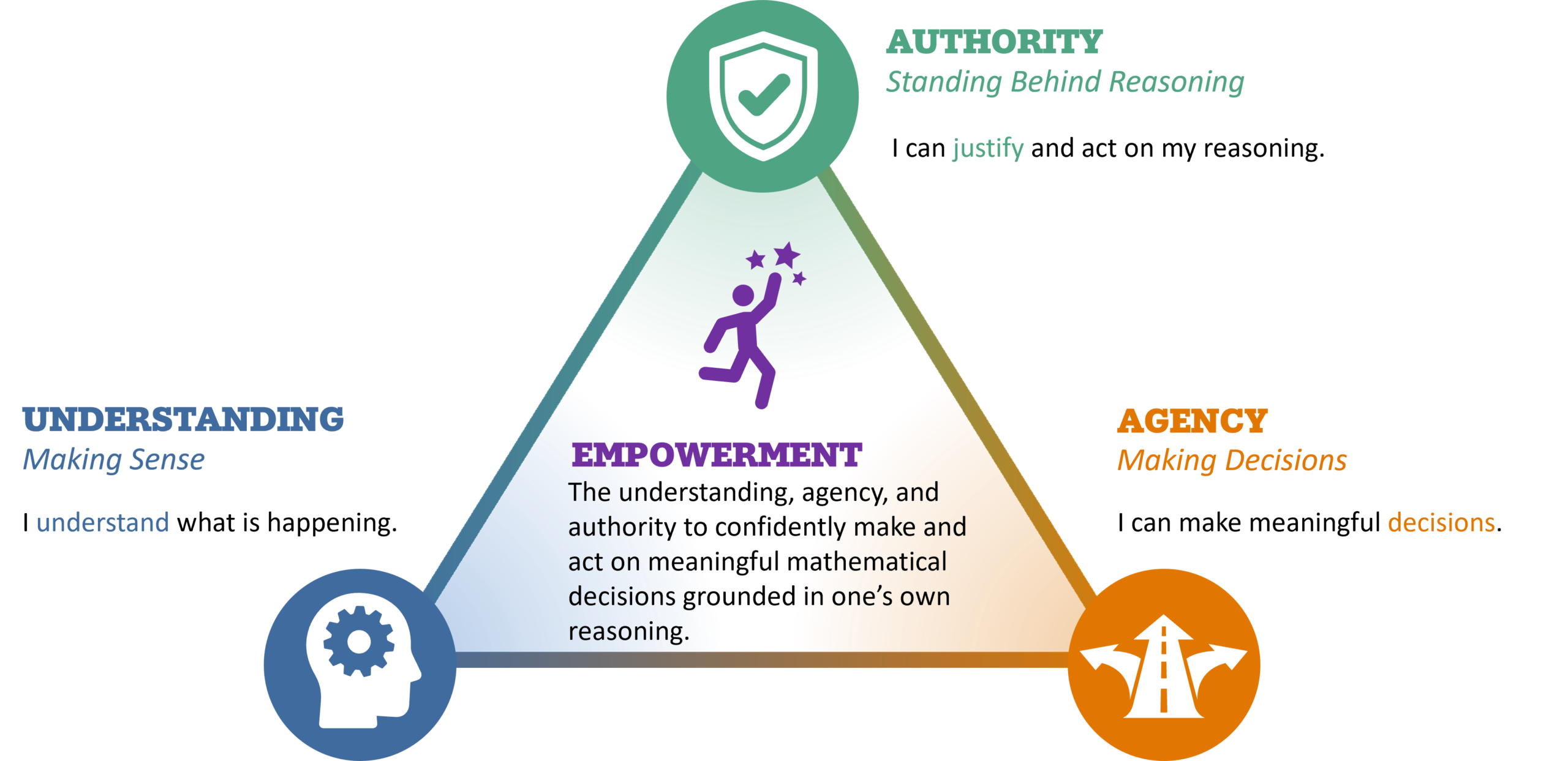
Mathematical empowerment is not a single trait that students either possess or lack. Rather, it emerges as students develop understanding, agency, and authority. As these capacities grow, so do students’ beliefs about themselves and their ability to participate meaningfully in mathematics.
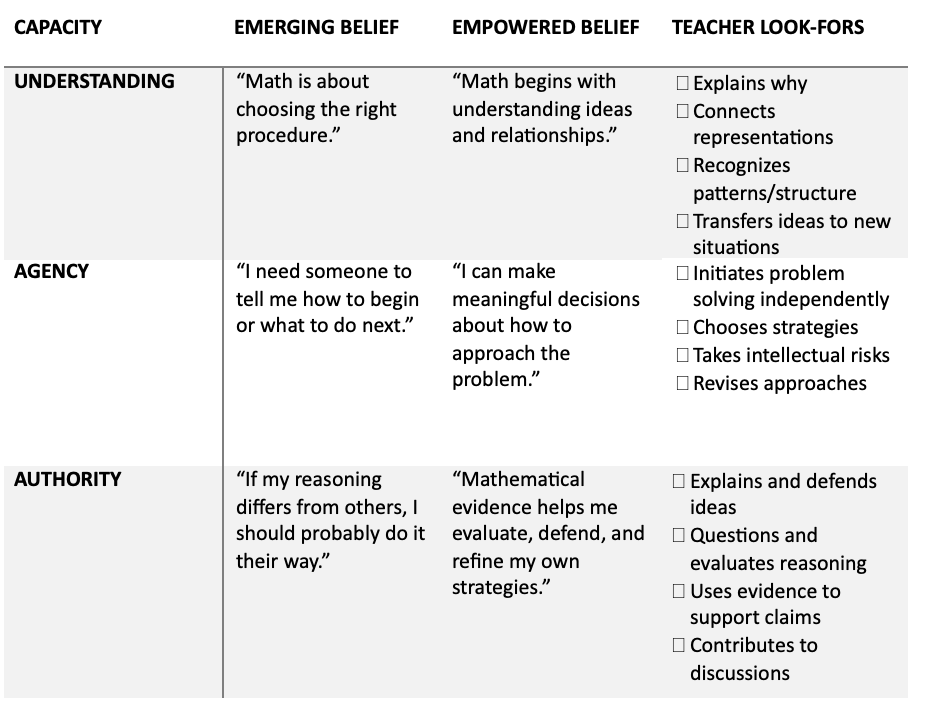
The sections that follow explore each of these capacities in greater depth and consider how classroom experiences can nurture their development.
Understanding: Building Meaning to Act
When students encounter a new mathematical situation, we want them asking, Can I make sense of what is happening here? rather than What procedure should I use to get the answer?
Understanding is the capacity to build meaningful connections among mathematical ideas, relationships, and representations. It is more than remembering facts or reproducing procedures. Students with understanding can explain why methods work, recognize patterns and structures, and use their knowledge flexible even in unfamiliar situations.
Understanding gives students something to reason with. Students who have developed understanding are better positioned to make decisions, adapt their thinking, and persevere when a solution is not immediately apparent. By contrast, when students view mathematics as a collection of procedures, even a small change in a problem can leave them feeling stuck.
Developing understanding is not simply about helping students to know more mathematics. It is about helping students to believe: I can make sense of mathematical ideas and relationships.
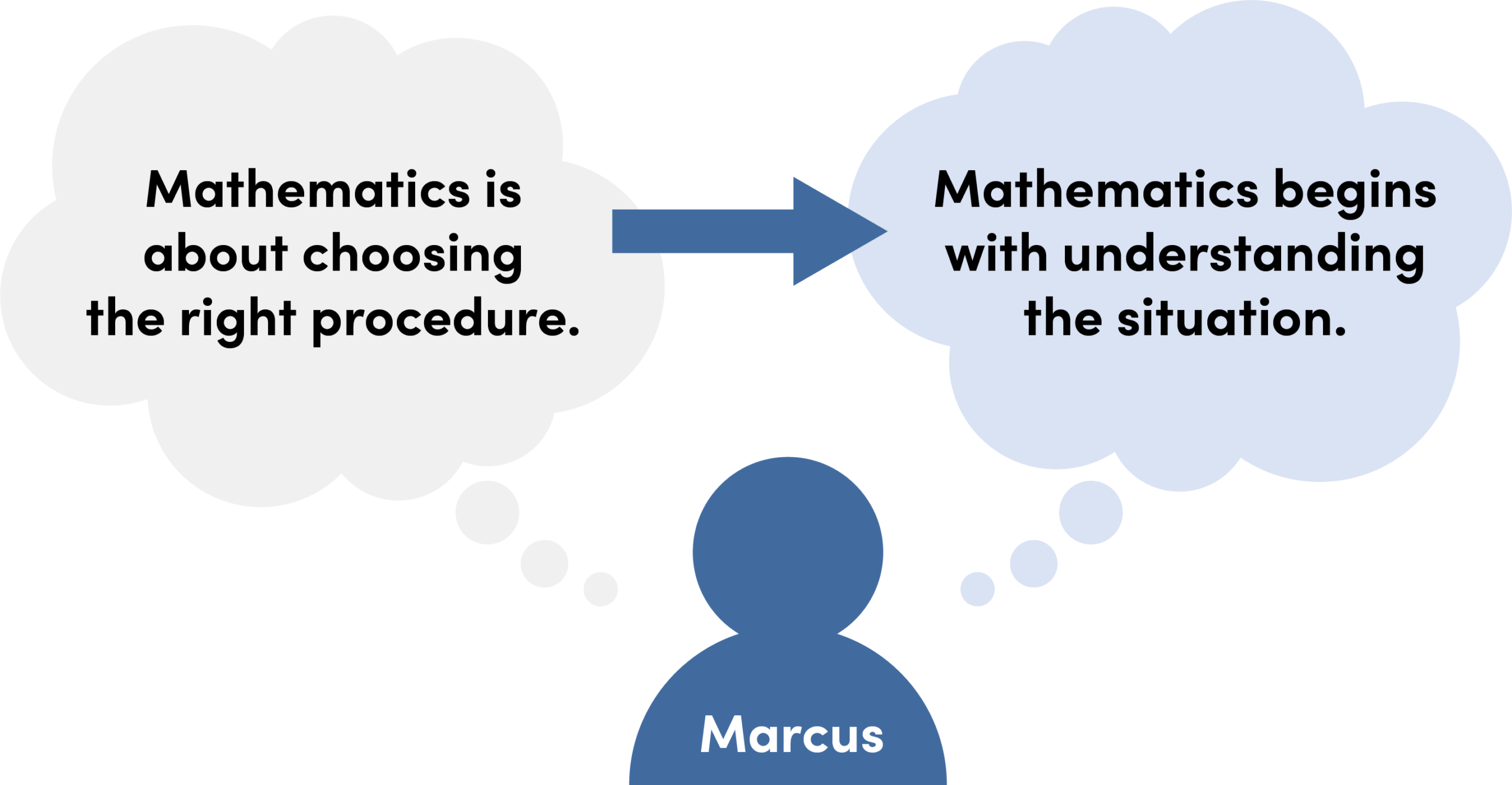
So what does a classroom that cultivates understanding look like?
Students are engaged in explaining their reasoning, connecting multiple representations, looking for patterns and structure in their work, and justifying why their methods work to themselves and their peers. They position mathematics as something to be understood, not merely something to be remembered.
Understanding alone, however, is not enough. Students may make sense of mathematical ideas and still hesitate to act on their thinking or make decisions about how to proceed. For that, they need another important capacity: agency.
Agency: Developing Confidence to Decide
Even when students understand the mathematics they are exploring, they do not always have the confidence to decide what to do next. Many students have learned that mathematics is a subject in which the teacher asks the questions, determines the methods, and signals when it is time to begin. As a result, students may possess meaningful understanding yet still wait for direction before taking action.
Agency is the capacity to see oneself as capable of making mathematical decisions and taking ownership of mathematical work. Students with agency do not simply follow a prescribed path; they make choices. They decide how to begin, which strategy to try, when to revise their thinking, and how to move forward when they encounter obstacles.
This capacity matters because meaningful problem solving is inherently uncertain. Challenging tasks rarely announce the correct starting point or provide a single obvious strategy. Students must make decisions, test ideas, and adapt their approaches along the way. Without agency, even students who understand important mathematical ideas may hesitate to engage fully in this work.
Developing agency is not simply about encouraging students to be independent. It is about helping students to believe: I can make decisions about how to approach and solve this problem.
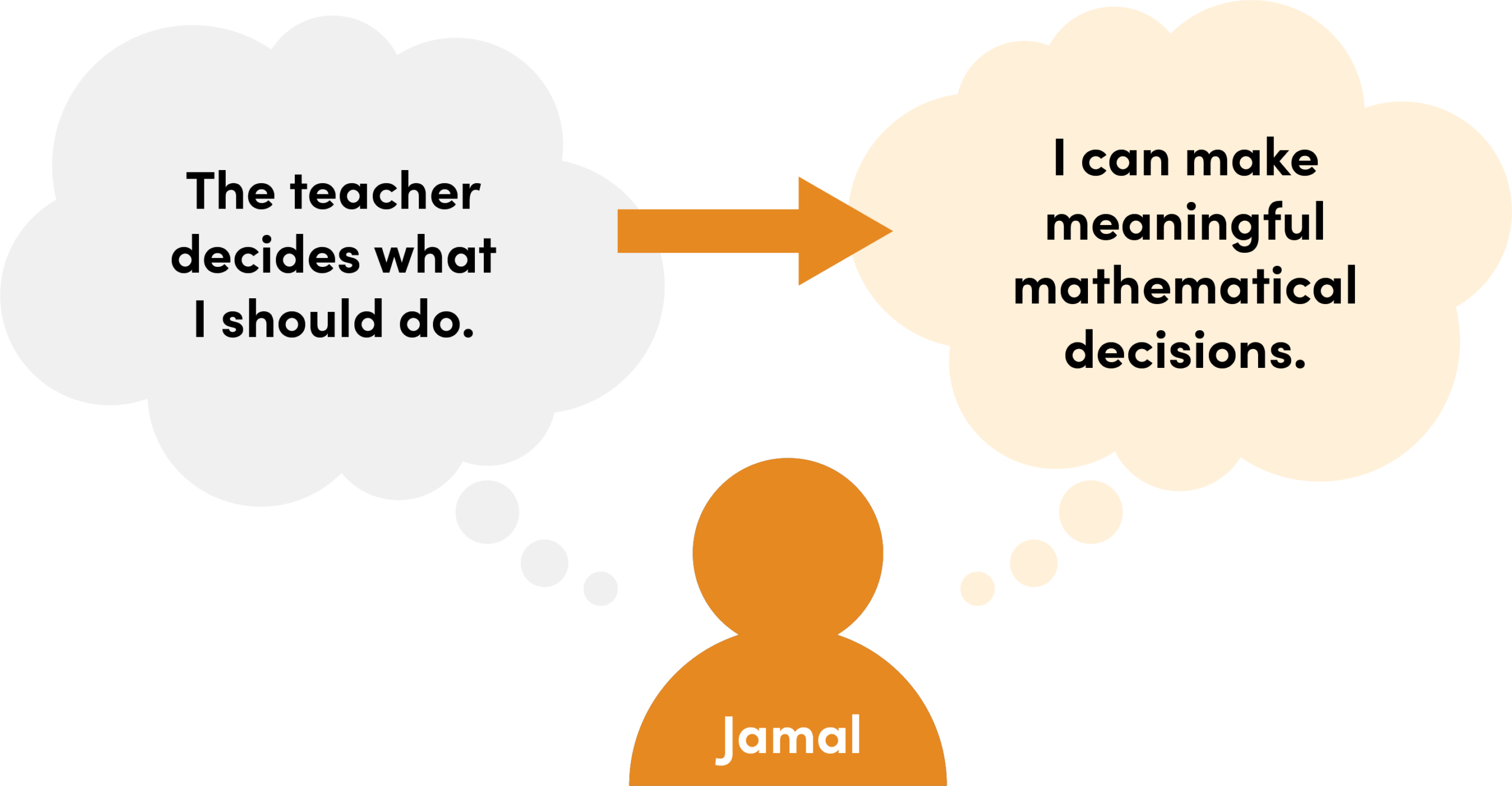
So what does a classroom that cultivates agency look like?
Students are invited to make choices, select strategies, compare approaches, ask questions, and determine next steps. They communicate that mathematical decision making is not the teacher’s responsibility alone, but it is an essential part of every student’s work as a mathematician.
Agency alone, however, is not enough. Students may understand the mathematics and feel empowered to make decisions. Yet they may still doubt their own reasoning when it differs from that of others. To contribute confidently and persist in the face of uncertainty, students also need a sense of authority.
Authority: Gaining Power to Trust
Students can understand important mathematical ideas and feel capable of making decisions, yet still hesitate to share, defend, or persevere in their own thinking. Many students have learned that the role of mathematics is to conform with expected approaches rather than develop and evaluate their own ideas. As a result, they may abandon sound reasoning simply because someone else used a different strategy or arrived at a different result.
Authority is the capacity to trust, justify, and persevere in one’s own mathematical reasoning. Students with authority recognize that mathematical ideas should be evaluated through evidence, logic, and argument—not trusted solely based on who contributed them. They are willing to explain their thinking, defend their conclusions, and revise their ideas when presented with convincing mathematical evidence.
This capacity matters because mathematics is a discipline of reasoning and justification. Mathematicians make claims, evaluate arguments, and determine whether their ideas make sense. Without authority, students may become overly dependent on external validation, looking to the teacher or peers to determine whether their thinking is correct.
Developing authority is not simply about convincing students they are always right. It is about helping students to believe: Mathematical evidence helps me evaluate, trust, and justify my own reasoning.
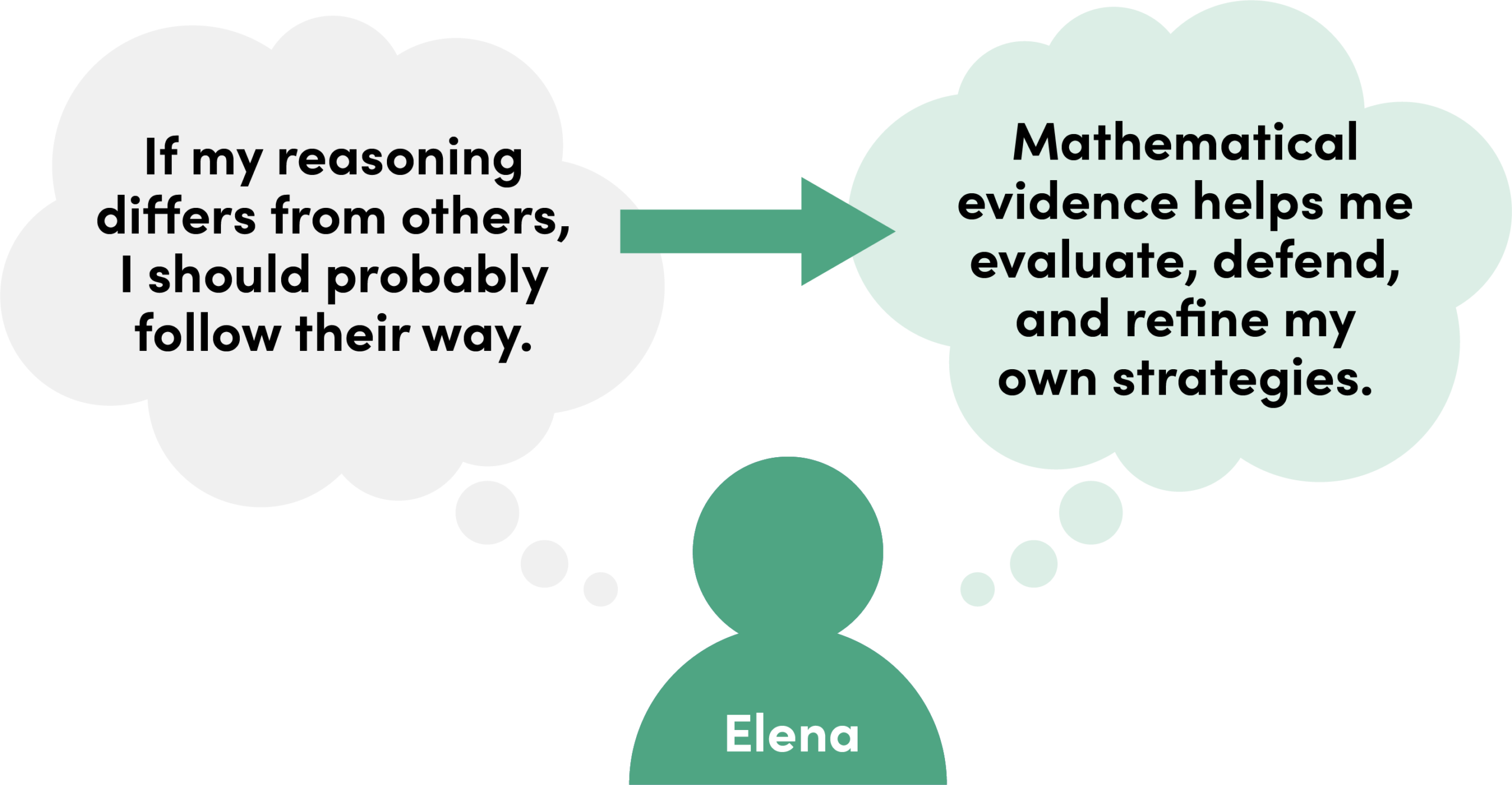
So what does a classroom that cultivates authority look like?
All students’ ideas are positioned as worthy of consideration. They invite students to explain and defend their reasoning, compare arguments, and use evidence to determine what is mathematically convincing. They communicate that mathematical authority does not reside solely with the teacher, the “smart” students, or the answer key. Instead, authority emerges through making decisions built from understanding, and then using evidence to justify those decisions, or to change course when needed.
When students believe that they can make sense of mathematics, decide how to proceed, and justify their thinking with evidence, they begin to do more than solve problems. They begin to see themselves as capable and empowered mathematical thinkers.
Mathematical Empowerment
Mathematical empowerment emerges at the intersection of understanding, agency, and authority. Together, these three capacities shape how students engage with mathematics and how they see themselves within it. When any one of these capacities is missing, students’ abilities to make sense of problems and persevere in solving them will be hindered.
Consider what happens when any one of these capacities is missing.
Students may possess meaningful understanding yet lack agency. They make sense of problems, recognize relationships, and may even generate ideas for how to proceed. But they wait to be told what to do next. Their understanding has not yet translated into action.
Students may demonstrate agency without sufficient understanding. They are willing to try ideas, take risks, and even persevere, but without meaningful relationships and connections guiding their thinking, their efforts can be unproductive.
Students may have both understanding and agency but lack authority. They make sense of mathematics and confidently pursue a strategy, but they are quick to abandon sound reasoning when they notice a classmate takes another approach or when the teacher asks probing questions. They have ideas, but they don’t yet trust those ideas enough to justify and defend them.
Empowered problem solvers need all three capacities.
They need understanding to make sense of mathematical ideas and relationships. They need agency to make decisions and take ownership of their work. And they need authority to trust, justify, and persist in their mathematical problem solving.
Perhaps, then, perseverance is not something we ask students to do. Rather, perseverance is often the visible expression of something deeper. Students persist when they understand enough to keep exploring, have the agency to make decisions about what to try next, and possess the authority to trust that their thinking is worth pursuing.
Empowered students do not persevere because they have been told to keep going. They persevere because they have developed the understanding, agency, and authority to believe that they can.