Achieving Equity-Mindedness and Meaningful Inclusion in Biology Lessons
The need for student identification and belonging in the scientific community begins in the biology curriculum. This requires equity-mindedness and meaningful inclusion that supports equitable classroom practices and equity science content and pedagogy. This presentation focus’ on the rationale and benefit to teachers and students for developing equity-mindedness for meaningful inclusion. These lesson ideas and strategies are supported by the 3-dimensions of the Next Generation Science Standards.
Dr. Catherine Quinlan
Associate Professor of Science Education Howard University
The need for student identification and belonging in the scientific community begins in the biology curriculum. This requires equity-mindedness and meaningful inclusion that supports equitable classroom practices and equity science content and pedagogy. This presentation focus’ on the rationale and benefit to teachers and students for developing equity-mindedness for meaningful inclusion. These lesson ideas and strategies are supported by the 3-dimensions of the Next Generation Science Standards.
In this webinar replay, you will:
Learn about the connection between identification and belonging and equitable classroom practices and science content
See examples from curriculum resources that bring equity into the biology classroom
Get ideas for including equity-based phenomena and diverse real-world scenarios
Making the Case for Teaching Mathematics Using Algebra-Based Financial Applications
There is an undeniable need for algebra-based, quantitative financial literacy. The goal of this session is to offer teachers a rationale and framework for creating and teaching a quantitative financial literacy high school mathematics course that is applications-oriented, technology-dependent, and suitable for students of all ability levels. Modeling finance using advanced algebra assists students in seeing the relevance of the mathematics they are learning
Richard J. Sgroi, Ph.D.
Author
Robert Gerver, Ph.D.
Author
There is an undeniable need for algebra-based, quantitative financial literacy. The goal of this session is to offer teachers a rationale and framework for creating and teaching a quantitative financial literacy high school mathematics course that is applications-oriented, technology-dependent, and suitable for students of all ability levels. Modeling finance using advanced algebra assists students in seeing the relevance of the mathematics they are learning.
In this webinar replay, you will learn:
Methods to introduce finance, build strength in mathematics, and assist in making that mathematics transferrable to other contexts
How math can be explored in the contexts of discretionary expenses, banking, credit, auto ownership, employment, taxes, housing, investing, entrepreneurship, retirement, and budgeting
What to tell students when they ask: “When are we ever going to use this?” - “Every day of your lives!”
Real World Forensics: How to Identify 9/11 Victims Using STR Profile Analysis
Use inexpensive DNA teaching models to help students understand the structure of DNA, chromosomes, genes, and STRs (Short Tandem Repeats). Engage students through phenomenon-based learning to solve the identity of a 9/11 victim using STR profile analyses of the victim, two young boys, and their mother. Observe how to present the STR profile analysis so that it is easily understood by all students. This activity uses the historical event of the 9/11 attack to integrate biology, history, technology, and math while focusing on a human-interest story.
Anthony “Bud” Bertino Patricia Nolan Bertino
Trainers, co-authors of Forensic Science: Fundamentals and Investigations
Use inexpensive DNA teaching models to help students understand the structure of DNA, chromosomes, genes, and STRs (Short Tandem Repeats). Engage students through phenomenon-based learning to solve the identity of a 9/11 victim using STR profile analyses of the victim, two young boys, and their mother. Observe how to present the STR profile analysis so that it is easily understood by all students. This activity uses the historical event of the 9/11 attack to integrate biology, history, technology, and math while focusing on a human-interest story.
In this webinar replay, you will:
Observe the use of inexpensive models to facilitate DNA instruction.
Observe how to present and analyze STR profiles using familial genealogy.
Review and receive multiple teaching resources including an activity worksheet, Teacher Notes, Student Learning Objectives, Outlines and Lesson Plans for immediate use with your students.
Chris Botello’s recently published book, Adobe® Photoshop Creative Cloud Revealed, 2nd edition, is packed with cutting-edge photography, creative design, and comprehensive content that engages and equips students with 21st Century skills to help them succeed in today’s emerging careers.
Offering more than just an overview of tips and tricks, Botello, in his passionate and engaging style, will present exercises in his book and demonstrate how to teach them. Viewers will gain valuable insight from the unique perspective of an author, graphic designer, professional Adobe user, and teacher.
Chris Botello
Author of best-selling textbooks on Adobe software, and Graphic Design Teacher at Sierra Canyon School
Chris Botello’s recently published book, Adobe® Photoshop Creative Cloud Revealed, 2nd edition, is packed with cutting-edge photography, creative design, and comprehensive content that engages and equips students with 21st Century skills to help them succeed in today’s emerging careers.
Offering more than just an overview of tips and tricks, Botello, in his passionate and engaging style, will present exercises in his book and demonstrate how to teach them. Viewers will gain valuable insight from the unique perspective of an author, graphic designer, professional Adobe user, and teacher.
In this webinar replay, you will:
Learn how to infuse Adobe Illustrator artwork in Photoshop to create astonishing color effects
Understand how to use Photoshop's layers and masks to create unique artwork
Gain a deeper understanding of the 256-shade grayscale range—and so much more
Teaching History and Science Using What? Incorporating Artifacts into Your Lessons
Bring the world into your classroom! Join Bill, Mark, and Andrea in this lively session where they’ll explore how to use actual artifacts to teach science and history. The artifacts may be represented in the textbook and digital program you are using or you may have an artifact at home from your travels. Material culture adds a dimension to learning that cannot be replaced by the written word. Let us demonstrate how to teach a lesson with artifacts from afar or from your own community — or your own home.
Dr. William Parkinson
Curator of Anthropology Field Museum, Chicago, IL National Geographic Society Grantee
Andrea Kingman
Exec. Product Marketing Manager National Geographic Learning | Cengage
Mark Hoffman
Senior Product Marketing Manager National Geographic Learning | Cengage
Bring the world into your classroom! Join Bill, Mark and Andrea in this lively session where they’ll explore how to use actual artifacts to teach science and history. The artifacts may be represented in the textbook and digital program you are using or you may have an artifact at home from your travels. Material culture adds a dimension to learning that cannot be replaced by the written word. Let us demonstrate how to teach a lesson with artifacts from afar or from your own community — or your own home.
In this webinar replay, you will leave with these fresh ideas:
Create a lesson around historical or scientific objects, providing their background and what they show about the world around them from their era;
Design a written inquiry project to encourage curiosity about things students may never have considered or observed;
Help students discover science and history in their own community and in their own home by asking each student to bring in an artifact that represents their culture.
Tips and Tricks to Enhance and Explode your CTE Digital Instruction Toolbox
Are you a secondary CTE teacher who is looking to incorporate some fresh new projects, tips and tricks, and digital content delivery in your classroom? Or perhaps you want to implement just a few digital content delivery opportunities to freshen up your already robust curriculum. This session provides strategies, lesson ideas, projects, digital tools, and technological approaches for teaching in this digital age in a variety of curriculums. Learn all these great resources and be assured that your digital toolbox will no longer close, as it will be exploding with new resources!
Jason Hendrickson
Business Instructor J. Everett Light Career Center MSD Washington Township
Megan Fileccia
Sr. Product Marketing Manager for Digital Learning Platforms National Geographic Learning | Cengage
Are you a secondary CTE teacher who is looking to incorporate some fresh new projects, tips and tricks, and digital content delivery in your classroom? Or perhaps you want to implement just a few digital content delivery opportunities to freshen up your already robust curriculum. This session provides strategies, lesson ideas, projects, digital tools, and technological approaches for teaching in this digital age in a variety of curriculums. Learn all these great resources and be assured that your digital toolbox will no longer close, as it will be exploding with new resources!
In this webinar replay, you will learn about:
Multi-platform strategies, lesson ideas, and digital tools for teaching a variety of content in a variety of classes;
Individual and collaborative classroom projects;
Technology applications and web resources to be used as a supplement to instruction.
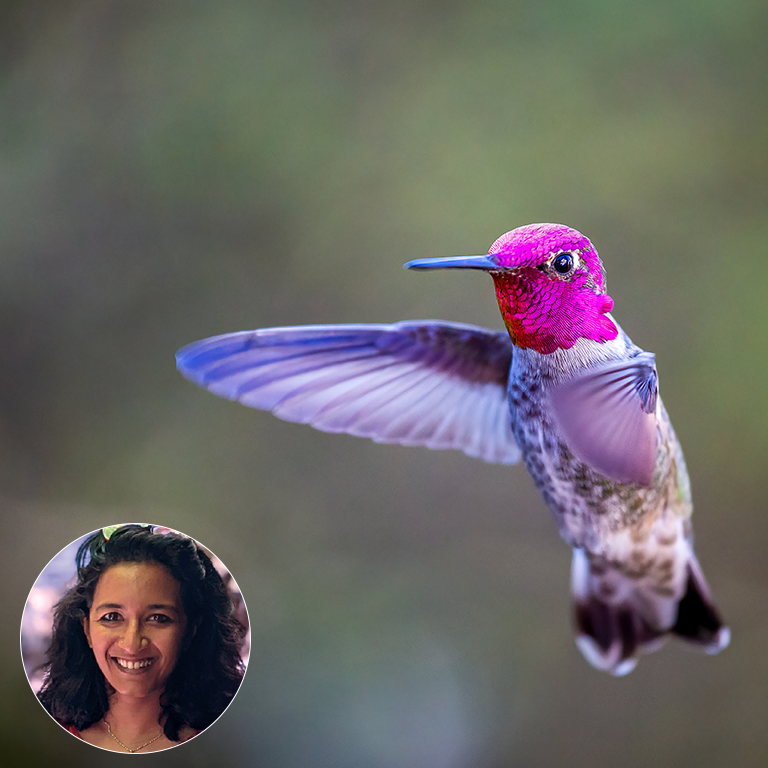
Collecting Data On Hummingbirds and Myself – Students Can Too!
Anusha Shankar has spent 9 years studying how hummingbirds manage their energy and their time. In the process, she started collecting data on herself – especially her moods and what they were influenced by, and her time and how she allocated it. Anusha thinks collecting information systematically on yourself can give you insight that is difficult to get any other way. And this might be a way students can learn more about themselves and their connection to the world around them! Anusha will share her hummingbird research with students in National Geographic Learning’s upcoming high school Biology program launching in late 2022.
Anusha Shankar
National Geographic Explorer, Rose Postdoctoral Fellow, Cornell Lab of Ornithology
Anusha Shankar has spent 9 years studying how hummingbirds manage their energy and their time. In the process, she started collecting data on herself – especially her moods and what they were influenced by, and her time and how she allocated it. Anusha thinks collecting information systematically on yourself can give you insight that is difficult to get any other way. And this might be a way students can learn more about themselves and their connection to the world around them! Anusha will share her hummingbird research with students in National Geographic Learning’s upcoming high school Biology program launching in late 2022.
In this webinar replay, you will:
Learn how hummingbird physiology relates to species adaptations in changing environments
Connect lesson ideas to NGSS Life Science standards
Understand how stories from diverse National Geographic Explorers can help students master high school biology concepts
Social and Emotional Learning in K-12 Math Classrooms
Katy Fattaleh
Senior Program Director • The Nora Project
Now, more than ever, Social/Emotional Learning (SEL) is a critical component of classroom instruction. Welcoming students back to in-person learning this year has meant learning how to support students in new ways after a traumatic 18 months. Students are showing up differently in our classrooms, requiring new and different support, and engaging in different ways than we are used to when it comes to their peers and their schoolwork. In order to rise to the occasion, teachers everywhere are turning to SEL to help students feel comfortable and confident in the classroom environment so that they are ready to learn.
The mathematics classroom is not always the first place we think of when we think about incorporating SEL, but when you think critically about it, SEL is truly embedded in the study of mathematics. Students engage in real-world problem solving, collaborate with their peers, weigh different approaches to solving problems, and discuss the merits of those solutions. By integrating SEL into daily instruction in small, simple ways, math teachers can build students’ skills and improve their ability to engage with mathematics content.
In our recent webinar, “Incorporating Social and Emotional Learning in K-12 Math Classrooms for a Changing World” Dr. Laurie Boswell, Courtney Adams, and myself dig into SEL’s role in the math classroom. We share more about what SEL is and give ideas for simple ways to weave it into your existing instruction. SEL does not have to be flashy, time-consuming, or even obvious. We share strategies for boosting students’ independence, interpersonal skills, and executive functions so that they can be their best selves in the math classroom.
For more information and tips for how to incorporate SEL on a daily basis in your math classroom and beyond, watch this webinar replay!
Incorporating Social and Emotional Learning in K-12 Math Classrooms for a Changing World
Presenters:
Laurie Boswell, Ed.D Award-winning math teacher, trainer, and Big Ideas Math® Author
Courtney Adams Director of Lifecycle and Community Programs at The Nora Project
Katy Fattaleh Senior Program Director at The Nora Project
Incorporating Social and Emotional Learning in K-12 Math Classrooms for a Changing World
Social and Emotional Learning (SEL) is needed now more than ever in K-12 classrooms. Students are coming into classrooms with more diverse school and life experiences than ever before with this changing world. Addressing your students’ social and emotional well-being is critical in ensuring your students are ready and available to learn. Do you know how easy it can be to incorporate it into math class, and beyond? Learn strategies and tools you can incorporate today!
Laurie Boswell, Ed.D.
Award-winning math teacher, trainer, and Big Ideas Math® Author
Social and Emotional Learning (SEL) is needed now more than ever in K-12 classrooms. Students are coming into classrooms with more diverse school and life experiences than ever before with this changing world. Addressing your students’ social and emotional well-being is critical in ensuring your students are ready and available to learn. Do you know how easy it can be to incorporate it into math class, and beyond? Learn strategies and tools you can incorporate today!
In this webinar replay, you will:
The importance of social and emotional learning.
How to be conscious of social and emotional learning to build community in the classroom.
Strategies and tools for incorporating social and emotional learning in math classrooms and across content areas.
Multimedia Storytellers • Suān tián kǔ là: The Flavors of Life
Join us in this three-part series as we bike 800 miles down Oregon and California, exploring the impacts of COVID and climate change in coastal communities. This series focuses on stories of people, place, and change.
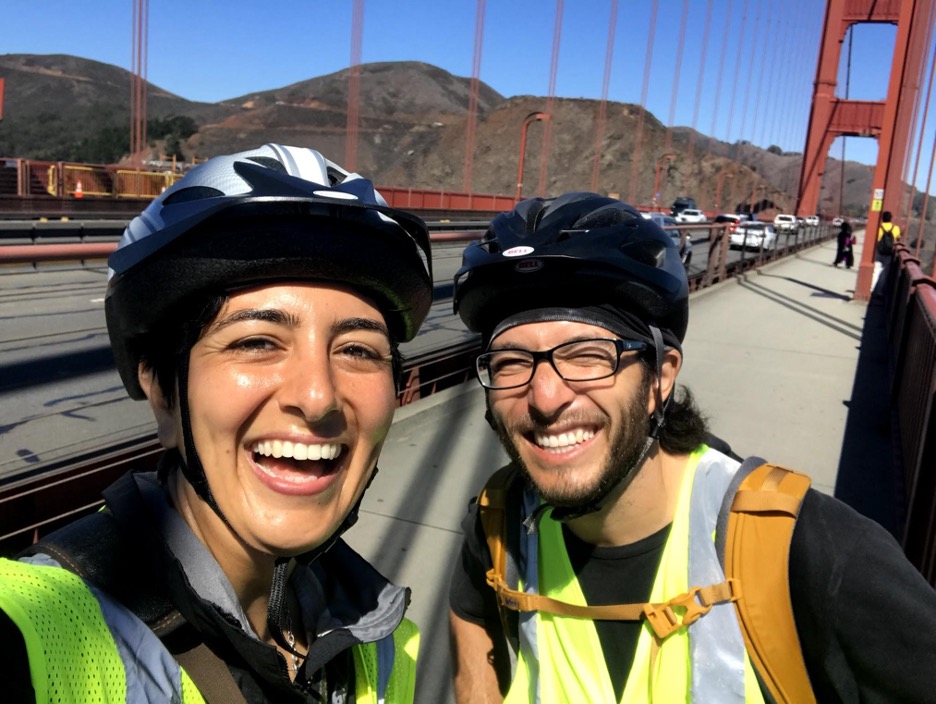
The City sprawled on the other side of the Bridge. White homes and glass monoliths, patches of grass and beach and trees covered the peninsula. From here it looked like a diorama, cut from construction paper and held together with cheap glue and invisible tape.
Our bikes stood against the railing. Compared to the bridges on the Oregon coast, the Golden Gate seemed so stable, its pathway so wide. And even still, I got a pulling in my stomach when I glanced over the edge.
We tried taking a few photos, tried shooting some video.
It felt like we needed to do something to celebrate, like we needed something to mark the fact that we’d biked all 800 miles.
But mostly, we just stood and looked out at the Bay.
As we crossed into San Francisco, dodging other cyclists, threading our way through hikers and walking groups and tourists taking selfies, I was surprised at the sheer number of people.
I was surprised too, that everyone here was actually wearing masks.
At the start of our trip, it struck me that COVID-19 really was affecting the rest of the world. Intellectually, I knew masks and social distancing weren’t confined to our hometown. But seeing it in person, recognizing other communities were also struggling through the pandemic, it made it feel more real.
And it made the divide feel more immediate.
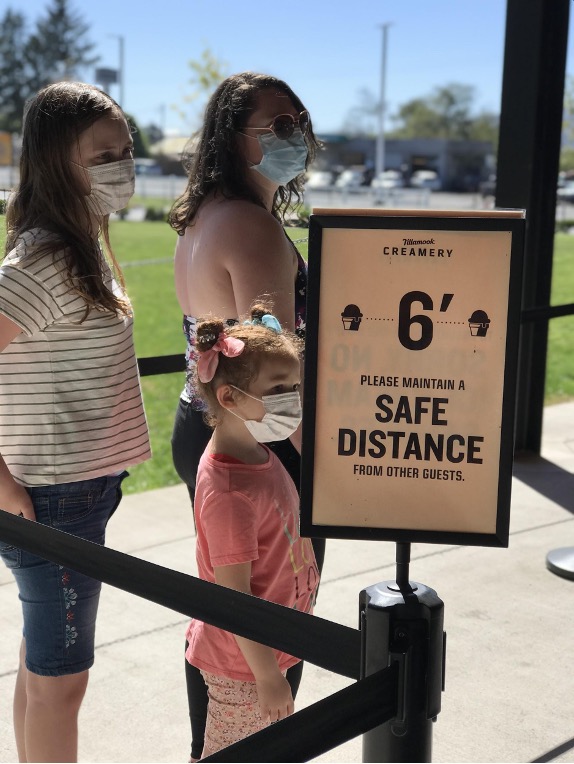
We saw it at the cafe in North Bend that didn’t mandate masks. It surfaced again in a Mendocino coffee shop, where a family flatly refused to wear face coverings. We felt it at the diner in Klamath where the waitress and cooks and customers–all maskless–stopped and stared at us like we’d walked in from an alternate reality.
We could feel the frustration–the frustration at the mixed messaging, at the constant changes. The frustration that businesses and individuals often feel when they’re left to figure it out on their own.
Mostly we saw people trying to make it work–they followed local guidelines, they put up signs. They adapted.
But everywhere we went, whatever the response, we could feel the fatigue, we could see the desire for normalcy. We could see the longing for things to get back to the way they were.
Everywhere we went, we could see that people just wanted to live their lives.
We walked the last three blocks. After being out on country roads for so long, all the cars rushing around and hunting for parking, the delivery trucks occupying half the street with their flashers on, the pedestrians looking down at their phones, the urban bikers ignoring traffic signals–it all seemed so overwhelming.
When we found the apartment, actually got inside, and leaned the bikes in the entry hall, we hugged.
“We made it,” I said. “We made it.”
We’d resolved to explore the City on foot today and tomorrow, to avoid the stress of navigating SF on wheels. We changed into dry clothes and headed out to find lunch.
Before walking out the door, we paused, and looked at our bikes. They stood there against the wall. And we left.
CLASSROOM APPLICATION
Our attitudes towards the virus and the way we’ve adapted are strongly influenced by our social environments and cultures. Consider how the pandemic has changed the way you view space, time, and people.
• Compare and Contrast: How has COVID-19 changed your social perceptions? Compare and contrast attitudes you’ve seen before and during the pandemic regarding personal space, punctuality, and how people interact with public areas.
• Create a Vlog: Pretend to be a Professor of Human Geography 30 years in the future preparing a lesson on the coronavirus pandemic. Discuss how social practices and life have changed in your community as a result of the pandemic.
• Creative Writing: Pick a favorite song and rewrite the lyrics to reflect the changes you’ve had to make as a result of the pandemic. How have these changes affected your perception of life before the COVID-19?
The Samples You Want Without The Wait!
Request samples for your classrooms without the hassle. Our new SampleNow site gives you access to hundreds of samples in minutes.